
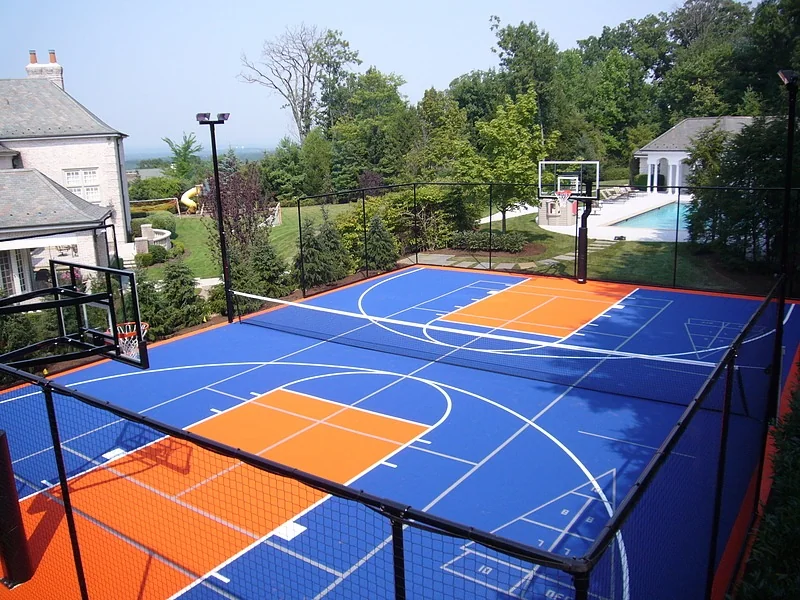
Can pickleball be played on a tennis court?
Yes. You can plan pickleball on an existing tennis court, but the lines, net and surrounding playing space need to work together. The pickleball boundary is 44 × 20 ft, compared with 78 × 36 ft for doubles tennis. First decide whether tennis will remain in use or the site will become a dedicated pickleball facility.
In this guide
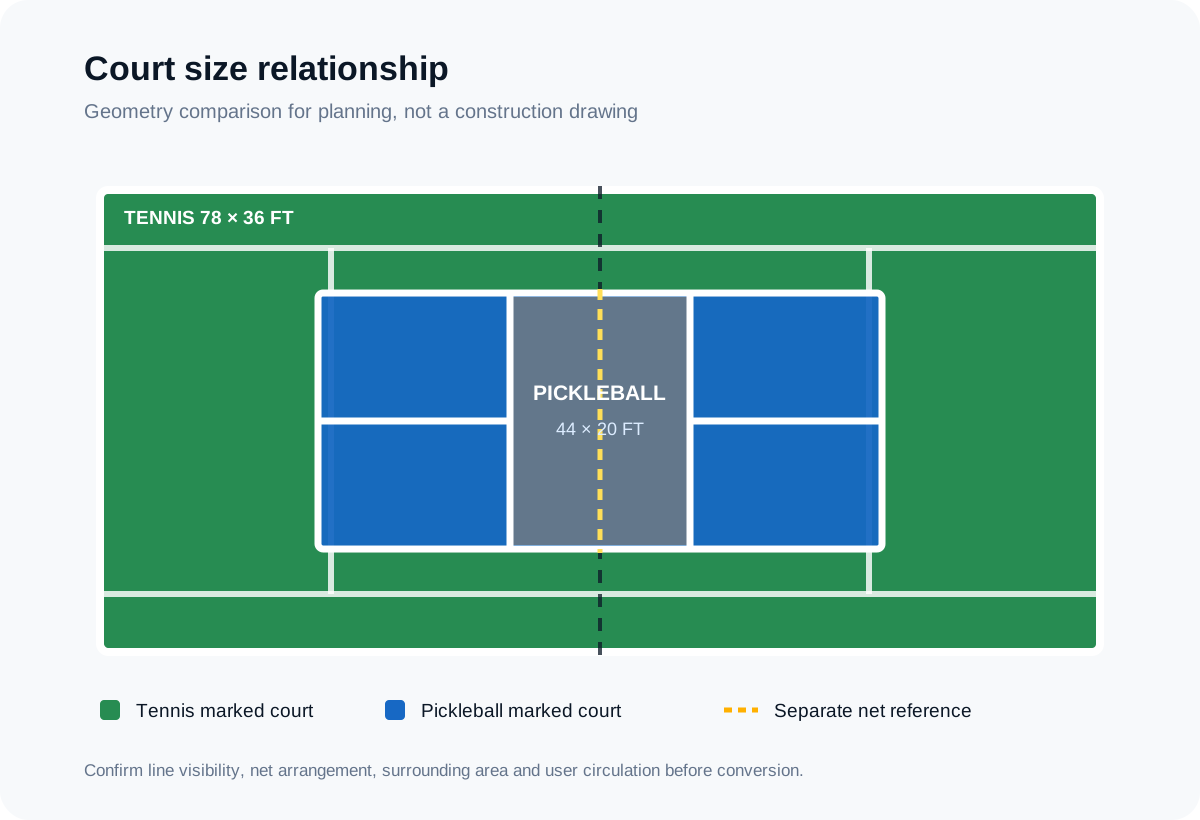
Pickleball and tennis court size comparison
| Marked layout | Length | Width | Marked rectangle area |
|---|---|---|---|
| Pickleball | 44 ft / 13.4112 m | 20 ft / 6.096 m | 880 sq ft / about 81.76 m² |
| Tennis, singles | 78 ft / 23.7744 m | 27 ft / 8.2296 m | 2,106 sq ft / about 195.65 m² |
| Tennis, doubles | 78 ft / 23.7744 m | 36 ft / 10.9728 m | 2,808 sq ft / about 260.87 m² |
Pickleball uses the same 44 × 20 ft boundary for singles and doubles. Tennis is 78 ft long, with a 27 ft singles width and 36 ft doubles width. For the line-by-line layouts, use the pickleball dimensions guide and tennis dimensions guide.
Possible layout arrangements
A single pickleball court can be centered or offset within the available tennis surface. A multi-court plan may also be possible when the complete site, fencing, fixed net posts, gates and circulation are measured. Do not choose a court count from the tennis rectangle alone.
Shared-use layout
Keep the tennis lines and add a clearly differentiated pickleball layout. Review how users will identify the correct baseline, sidelines, kitchen lines and centre lines.
Dedicated conversion
Make pickleball the primary marked use. The surface, colors, net plan and surrounding project scope can be planned around the new purpose.
Multiple pickleball courts
Measure the full site and define space between courts, perimeter access and net locations. Treat each court as regulation 44 × 20 ft geometry.
The diagram shows one geometric relationship. It is not a claim that every existing tennis facility can accept the same placement or court count.
Plan lines and colors for fast recognition
Shared courts can become difficult to read when every line has similar contrast. Use one coherent line color for the pickleball boundary, kitchen and centre lines, then check it against both the main surface and the retained tennis markings.
- Keep each sport’s complete geometry intact.
- Use color contrast to separate sport lines and playing zones.
- Do not treat the net reference as a painted floor line.
- Confirm fixed posts, sleeves and portable net storage outside the tile-only plan.
- Review the full tiled footprint, not only the marked rectangles.
Temporary vs dedicated project decisions
| Decision | Temporary or shared use | Dedicated conversion |
|---|---|---|
| Primary sport | Tennis remains visible alongside pickleball | Pickleball becomes the main planning basis |
| Lines | Added lines must remain readable without confusing both sports | A pickleball-first line plan can be developed |
| Net | Portable or changeable arrangements may be reviewed | Net locations can be planned around dedicated use |
| Surface scope | Existing surface condition and compatibility need review | The full flooring and perimeter scope can be quoted together |
| Procurement | Confirm what is retained and what is newly supplied | Confirm base, tile model, colors, lines, trim and installation scope |
Document the conversion before selecting flooring
Record the complete measured site, fencing, gates, fixed net posts, existing lines and surface condition. Then decide whether the site will remain shared-use or become pickleball-first, confirm the net approach, and mark which tennis lines are retained, removed or supplemented. Court count must be checked against the whole measured site and circulation plan, not calculated by dividing the 78 × 36 ft marked tennis rectangle.
Settle the retained lines, net arrangement and available space before comparing surfaces. The Pickleball and Tennis application pages cover flooring selection for each use.
Movevia modular flooring is one project option for a dedicated or reconfigurable surface plan. Product choice still depends on the measured area, existing base, intended use, selected model and supply scope. Review both the Pickleball Flooring Application and Tennis Flooring Application before requesting a quotation.
Pickleball on tennis court questions
Can the tennis net be used for pickleball?
The sports use different net height references and project arrangements. Confirm whether the existing net can be adjusted appropriately or whether a separate pickleball net system is needed.
How many pickleball courts fit on a tennis court?
The answer depends on the complete measured site, surrounding area, fencing, gates, fixed equipment and circulation. The verified court envelopes establish geometry but do not approve a universal court count.
Do shared lines need official approval?
This guide does not claim approval for a shared layout. Confirm the rules and operational requirements that apply to the intended venue or competition.
Can the Court Designer show both sports at once?
Yes. Design Your Court supports multi-sport planning. Check the position of each sport, the net arrangements and the complete site dimensions. A combined preview helps explain the layout; fixed posts, access and installation still need a site-specific review.
What must be measured before converting a tennis court to pickleball?
Measure the complete surface, fencing, gates, fixed equipment, net-post locations, circulation space and any surrounding area that may be tiled. Record the existing lines and surface condition before choosing a shared or dedicated layout.
Does converting the lines also determine the flooring system?
No. Line and layout decisions define the conversion plan. Flooring selection still depends on the base, intended use, site conditions, selected system and commercial scope; review the relevant Pickleball or Tennis Application separately.

 +86 153 5079 0183